

We built 1331, a two-outlet cafe in Vadodara, a data platform that turns raw point-of-sale exports into clean sales reports and ready-to-use marketing lists. Before it, the cafe's order data sat in spreadsheet exports from its POS system, Petpooja, with no easy way to answer questions like "who are our matcha regulars?"
| Measure | Result |
|---|---|
| Orders processed in the first two weeks | 2,155 bills, 5,738 line items |
| Customer profiles built | 1,109, each tagged by taste and lifecycle stage |
| Taste rules applied to the menu | 81 rules across 207 menu items |
| Data checks on every run | 4 reconciliation checks on every run |
| Outputs | Daily 2-page report, 7-page owners' insights report, marketing audience lists |
Figures cover 1 to 14 November 2026, the platform's first two weeks, across both outlets.
The challenge
The cafe had plenty of data but no way to act on it: every order lived in Petpooja, and the only way out was a manual spreadsheet export.
The owners wanted answers the POS screens could not give:
- Who orders matcha, cold brew or hot chocolate, so each group gets the right offer?
- Who are the high spenders, and who has stopped coming back?
- How does the new outlet, opened on 6 November 2026, compare with the original?
The raw exports made this hard:
- Overlapping exports. The same bill appears in several downloads, so naive totals double-count.
- Shifting layouts. Header rows move and new columns appear between exports.
- Messy values. Money with thousands separators, phone numbers in many formats, item names spelled differently.
- Late trading. The cafe trades past midnight, so a calendar day splits one night's sales in two.
- Customer privacy. Phone numbers are personal data under India's DPDP Act 2023, and marketing messages must respect opt-outs.
The solution
We built a layered pipeline that takes each POS export from raw file to checked, customer-level data, then produces reports and marketing lists from it.
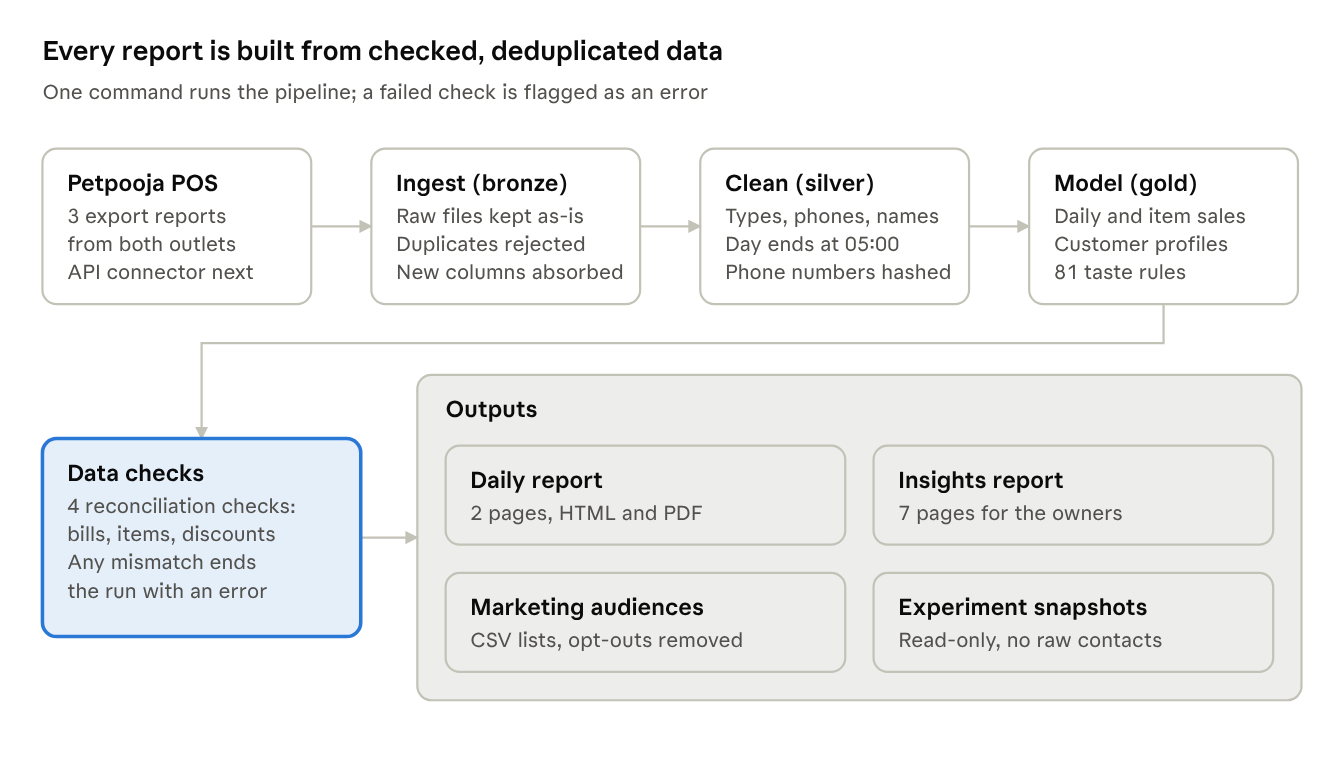
Each layer has one job. Bronze stores files exactly as received, silver applies the cleaning rules, and gold holds the tables the business reads. Taste tags come from 81 simple, editable rules that match menu items, so the owners can add a new drink to a segment without a developer.
Technology and engineering decisions
The platform is a small Python and DuckDB stack that runs on one machine, with no servers or cloud bills to pay.
| Area | What we used | Why |
|---|---|---|
| Language and tooling | Python, uv, a cafe command-line tool | One command runs the whole pipeline |
| Warehouse | DuckDB, in bronze, silver and gold layers | Fast analytics in a single file, no database server |
| Transformations | Plain SQL files, run in order | Easy to read, review and change |
| Configuration | YAML for reports, taste rules and calendar events | Menu and marketing rules change without code changes |
| Reports | Jinja2 templates, rendered to PDF with headless Chromium | Branded reports in the cafe's own colours and fonts |
| Testing | pytest on synthetic data, plus 4 data checks per run | Real customer data never enters the test suite |
Decisions that matter to the owners:
- Ready for the Petpooja API. Today the input is manual exports. The API connector is designed to produce the same batches, so switching later changes nothing downstream.
- Rebuildable from scratch. Raw files are kept exactly as received, so the whole warehouse can be rebuilt with one command and gives the same result.
- Privacy by design. Phone numbers are hashed with a secret salt, so analysis runs on anonymous keys. Real numbers are joined back in only when a marketing list is exported, and the do-not-contact list is always applied.
- Honest reports. Every report states the dates it covers, and a day still in progress is never shown as complete.
- Safe space for experiments. New ideas, like a planned Bluetooth footfall study, read frozen snapshots of approved tables and can never see raw contact details.
Results
In its first two weeks, the platform turned 2,155 bills from both outlets into 1,109 customer profiles the owners can market to directly.
- Customers by lifecycle: 1,019 new, 68 returning and 22 regular customers, each with taste tags such as matcha, cold brew or hot chocolate.
- Two outlets side by side: 1,738 bills at the original outlet and 417 at the new one since it opened on 6 November.
- Reports on demand: a branded 2-page daily report and a 7-page insights report for the owners, as HTML and PDF.
- Ready-made audiences: CSV lists per taste and lifecycle segment, with opt-outs removed, for WhatsApp and other campaigns.
- Trustworthy numbers: bills, line items and discounts reconcile on every run, and test bills are excluded automatically.
- Data gaps made visible: about 60% of bills carry a phone number, which gives staff a clear target for capturing contacts at the counter.
Next steps already planned: the Petpooja API connection to remove manual exports, a nightly scheduled run, and a loyalty program built on the same customer profiles.
How we build custom data pipelines
Most businesses already have the data they need, locked inside a POS, a CRM, an ERP or a pile of spreadsheets. Our Custom Data Pipelines service turns it into reports and actions you can trust.
- Start from the questions. We list the decisions the data should support before writing any code.
- Keep raw data untouched. Every source is stored exactly as received, so results can always be rebuilt and audited.
- Clean once, in one place. Deduplication, type fixes and business rules live in readable SQL, not scattered spreadsheets.
- Check before you report. Totals reconcile on every run, so a bad export never reaches a report.
- Protect personal data. Customer details are pseudonymised and only joined back where they are needed.
- Deliver where people work. PDF reports, dashboards, CSV exports or APIs, in your own branding.
To talk about your data, start a project or email info@thesyntaxstudio.com.
- #case-study
- #data-pipelines
- #analytics
- #marketing