

We built a digital media publisher an automated pipeline that turns an approved idea into a scheduled video with almost no manual production work. The publisher runs a network of faceless video channels: no presenter on camera, only narration over visuals.
| Measure | Result |
|---|---|
| Channel concepts in the system | 11 |
| Videos produced | 216 |
| Videos uploaded to channels | 183, in the first 26 days of publishing |
| Busiest channel's schedule | 7 long videos and 21 Shorts a week; 95 videos published so far |
| Manual production steps left | Approval and quality checks only |
Client and channel names are kept private. Figures come from the pipeline's own records as of 17 November 2026.
The challenge
Each video needed hands-on work in seven separate tools, so output was capped by people's time. The manual process looked like this:
- Study a niche and its successful creators by hand.
- Paste writing prompts into a chat assistant to draft the script.
- Record the voice-over in a text-to-speech web app.
- Generate images in one web tool, then animate each one in another.
- Edit everything together by hand in a video editor.
- Design the thumbnail by hand.
- Upload, write the description and schedule by hand.
Every hand-off between tools meant downloading, renaming and re-uploading files. A daily schedule across several channels was out of reach, and quality depended on who did the work that day.
The solution
We replaced the seven-tool workflow with one pipeline that carries each video from idea to scheduled upload, with people stepping in only where judgement matters.
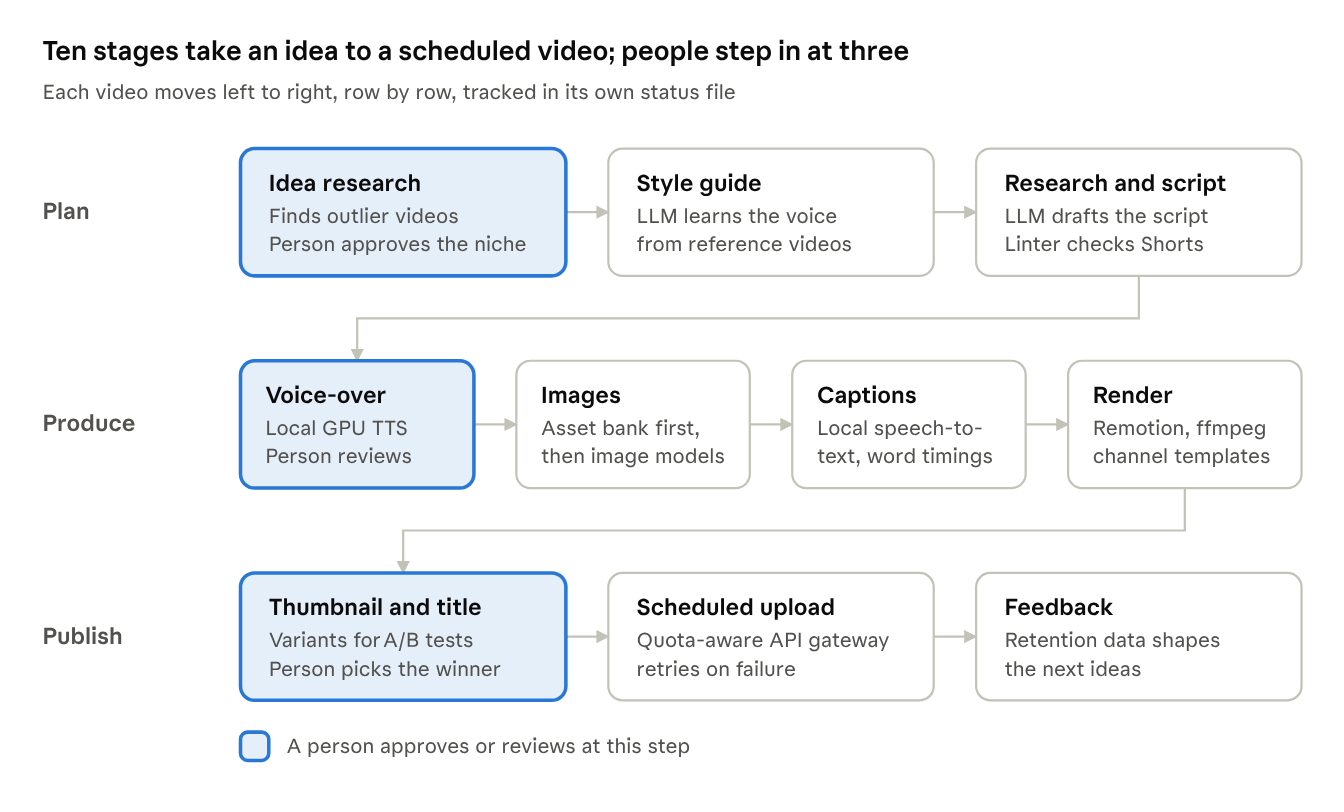
An AI agent runs the stages from written runbooks and records progress in a status file for each video. When a step needs a person, the video waits in a hand-off state and appears on a dashboard, so nothing is lost between steps. Heavy work like voice-over and image generation runs through queues, so many videos move through the pipeline at once.
Technology and engineering decisions
The pipeline is built to run cheaply on owned hardware first and to fall back to paid APIs only when asked.
| Area | What we used | Why |
|---|---|---|
| Orchestration | An AI coding agent following written runbooks, with state in a status file per video | Any capable agent can run it, and a person can pick up any video mid-way |
| Script writing | Large language models, guided by a style guide extracted from reference videos | One consistent voice per channel |
| Voice-over | Open-weight text-to-speech on local GPU workers, with a hosted TTS API as an option | Low running cost; paragraphs are cached so edits only re-voice what changed |
| Images | A queue that reuses a searchable asset bank first, then calls image models | Fewer generations, and work pauses and resumes when a usage allowance runs out |
| Captions | Local speech-to-text | Accurate word timings with no per-minute fees |
| Rendering | Remotion (React) and ffmpeg | Video layouts written as code, so every channel's look is a reusable template |
| Publishing | A gateway to the platform's API that tracks quota and retries uploads | Reliable scheduled uploads without manual steps |
| Queues and storage | SQLite, with local embeddings for image search | No extra database servers to run |
| Operations | Docker, systemd timers, a live dashboard and tiered backups | Runs unattended on a single machine |
Two decisions shaped the result:
- Quality gates over speed. A voice-over is only written when every paragraph passes pace and completeness checks. A Shorts checker flags scripts likely to lose viewers early.
- Published work is frozen. Once a video is live, no tool can regenerate it, so a re-run never changes what an audience has already seen.
Security is part of the build: dependency and secret scanning run on every change, and credentials stay outside the repository.
Results
The publisher went from hand-made videos to 183 uploads across its channels in the first 26 days of publishing (23 October to 17 November 2026).
- Volume: 216 videos produced across 11 channel concepts, 159 marked published, most of them 1-minute Shorts plus about 50 long videos of 8 to 25 minutes.
- A daily channel became possible: the busiest channel runs a fixed rhythm of 7 long videos and 21 Shorts a week.
- People focus on judgement: the team now approves ideas, reviews voice-overs and picks thumbnails, while the pipeline handles writing, voice, images, captions, rendering and uploads.
- Learning built in: audience-retention data from the platform feeds back into the pipeline, and weak Shorts can be re-made from the same assets.
- Low running cost: voice-over, captions and image search run on owned hardware, so paid APIs are an option rather than a per-video cost.
The audience numbers are still early, so this case study reports production results only.
How we can do this for you
The same approach works for any repetitive process that turns inputs into finished output: reports, product listings, documents or media. The Syntax Studio offers it through two services: AI Agent Development and Business Process Automation.
- Map the manual process step by step, with the people who do it today.
- Automate the reliable steps first and keep people on the decisions that need judgement.
- Add checks at every stage so bad output is caught before anyone sees it.
- Run it on infrastructure you control, with paid services as an option, not a dependency.
- Measure and improve using real results once it is live.
To talk about your process, start a project or email info@thesyntaxstudio.com.
- #case-study
- #automation
- #ai-agents
- #video